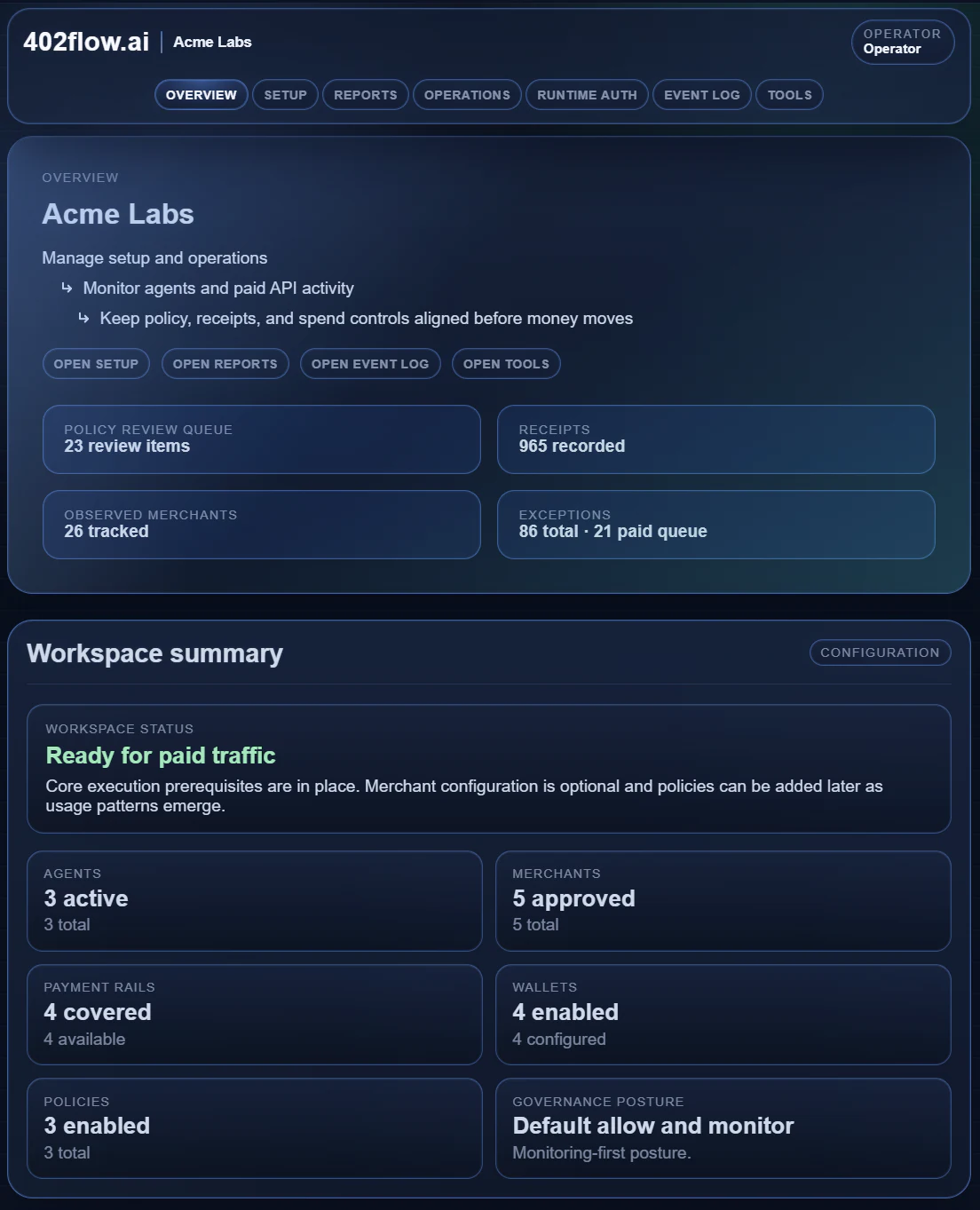
402flow is the control plane for AI agent spend. We are selecting a small number of teams to connect real workflows, test spend controls, and shape the requirements for production use.
Once agents can discover services and spend inside automated workflows, teams need clear answers before and after every paid request.
01Which agent made the request?
02What did the agent attempt to buy?
03Which policy or organization posture made the decision?
04Which wallet, network, and asset were used?
05Did the payment settle?
06How much money moved?
07Did the merchant deliver the resource?
08Where does an operator need to act?
What 402flow provides
Control before spend. Evidence after execution.
01
Control before payment
402flow authenticates the agent and evaluates organization posture, applicable spend policy, merchant constraints, and payment requirements before money moves.
Default allow and monitor supports fast adoption and policy refinement from live traffic.
Deny by default blocks paid requests unless policy allows them.
Policy limits support per-request caps and aggregate budgets.
Reviewable denials preserve the agent, merchant, amount, decision, and reason.
02
One connected operating record
Each paid request connects identity and policy to execution evidence, settlement, fulfillment, and operator follow-up.
Agent and runtime identity
Merchant, resource, and request details
Policy decision and authorization basis
Payment attempt, transaction context, and receipt
Settlement evidence and fulfillment result
Errors, review events, and triage history
03
Insight across agent activity
Reports turns individual request records into a practical view of spend, outcomes, concentration, and policy pressure.
Spend over time and activity by network and asset
Completed, failed, and denied requests
Authorization reasons and policy boundaries
Top agents and merchants
Repeated pressure against spend limits
Direct paths from aggregate signals to review
Available today
A working integration and operating surface.
Integration
Public SDK for paid API requests
Runtime credentials tied to specific agent identities
Governed x402 execution through the public SDK
Hosted control plane and operator console
Governance
Default allow and monitor or deny by default
Organization-, agent-, and merchant-scoped policies
Per-request and aggregate spend limits
Policy review workflow and denial reasons
Execution evidence
Payment attempts and transaction context
Receipt and fulfillment records
Chain Observer settlement verification
Base and Solana support
Operations
Complete request lifecycle inspection
Investigation views for execution errors
Managed triage for paid fulfillment failures
Spend, agent, merchant, and policy reporting
The pilot
One workflow. A bounded technical engagement.
The pilot can run in a test or controlled payment environment. Production data, deployment, and mainnet spending are optional and require agreement from both teams.
01
Connect one real or production-relevant paid API workflow.
02
Configure runtime identity, wallet access, and spend policy.
03
Exercise governed allow and deny paths.
04
Review receipts, settlement evidence, fulfillment, and reports.
05
Meet weekly to assess the operating model and product fit.
A strong fit
Built for teams with a real paid-agent use case.
The strongest partners operate AI agents, use paid APIs or expect to soon, and have a technical owner who wants better spend control, evidence, and troubleshooting.
The partner brings
One technical owner
One representative agent workflow
A test or controlled payment environment
Relevant request, authentication, and payment-flow details
One weekly operating and feedback session
A successful pilot proves
Each request is tied to an authenticated agent identity.
Policy controls which requests can proceed.
Requests that violate policy stop before payment.
Allowed requests use the governed execution path.
Operators can inspect payment, settlement, fulfillment, and receipts.
Reports provide useful insight into agent activity and spend.
Start with the evidence
Watch the demo. Then bring one workflow.
A 30-minute technical fit call covers the agent, its paid API dependencies, the current payment path, required controls, and the criteria for a useful pilot.